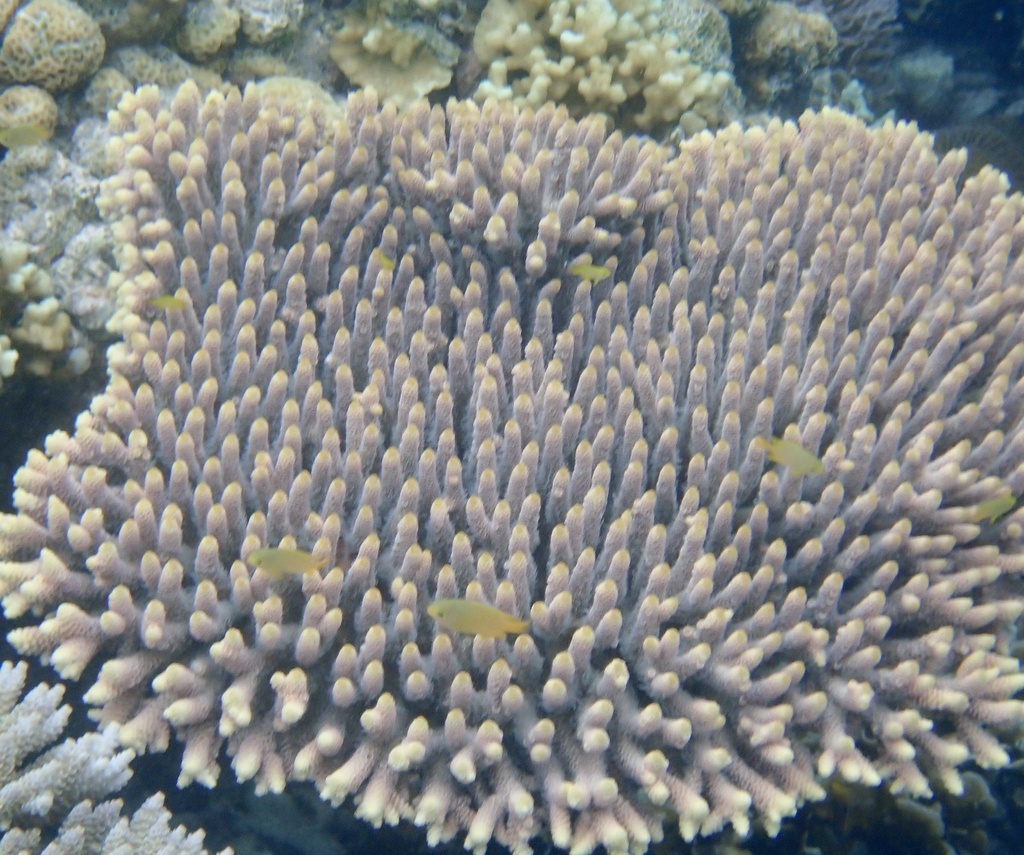
About Acropora Millepora
Acropora millepora is one of the most widely-kept branching SPS corals, native to the western Indo-Pacific. It grows in dense bushy colonies and exhibits a wide range of color morphs under appropriate lighting and flow.
Acropora millepora is a species of branching stony coral native to the western Indo-Pacific where it is found in shallow water from the east coast of Africa to the coasts of Japan and Australia. It was first described in 1834 by Christian Gottfried Ehrenberg as Heteropora millepora.
Notes from the editors
What it looks like. Branching SPS coral with short, stubby branches densely packed with small polyps. Color morphs range across vivid pinks, oranges, greens, and blues — often named after their dominant hue (e.g. "Rainbow Millepora," "Pink Lemonade Millepora").
In your tank. Forms bushy colonies that grow vertically and outward. Reef-safe and non-aggressive to neighbors, but will sting other corals if branches touch. Reliable growth indicator: healthy specimens extend their polyps during the day rather than only at night.
Placement and care. SPS-grade requirements — stable parameters above all else. Alkalinity swings of more than 0.5 dKH/day will cause rapid tissue necrosis (RTN). Mount in the upper third of the tank under strong, turbulent flow and high PAR. Do not move once placed.
Sourcing and feeding. Captive-bred frags are widely available ($25–60 for small frags, more for designer color morphs). Wild-collected specimens still appear but offer no real advantage. Photosynthetic with supplemental feeding of phytoplankton, amino acids, or fine particulate coral foods accelerating growth.
Care info is a starting point, not a guarantee. Individual specimens, water chemistry, and tankmate dynamics vary. Verify against multiple sources and adjust to what you observe. See our terms & disclaimers.
Related corals

Sources & attribution
- Taxonomy and accepted name from the World Register of Marine Species (WoRMS AphiaID 207023).
- Description content adapted from Wikipedia, available under CC BY-SA 4.0.
- Photo: iNaturalist · CC0 (via iNaturalist or Wikimedia Commons).