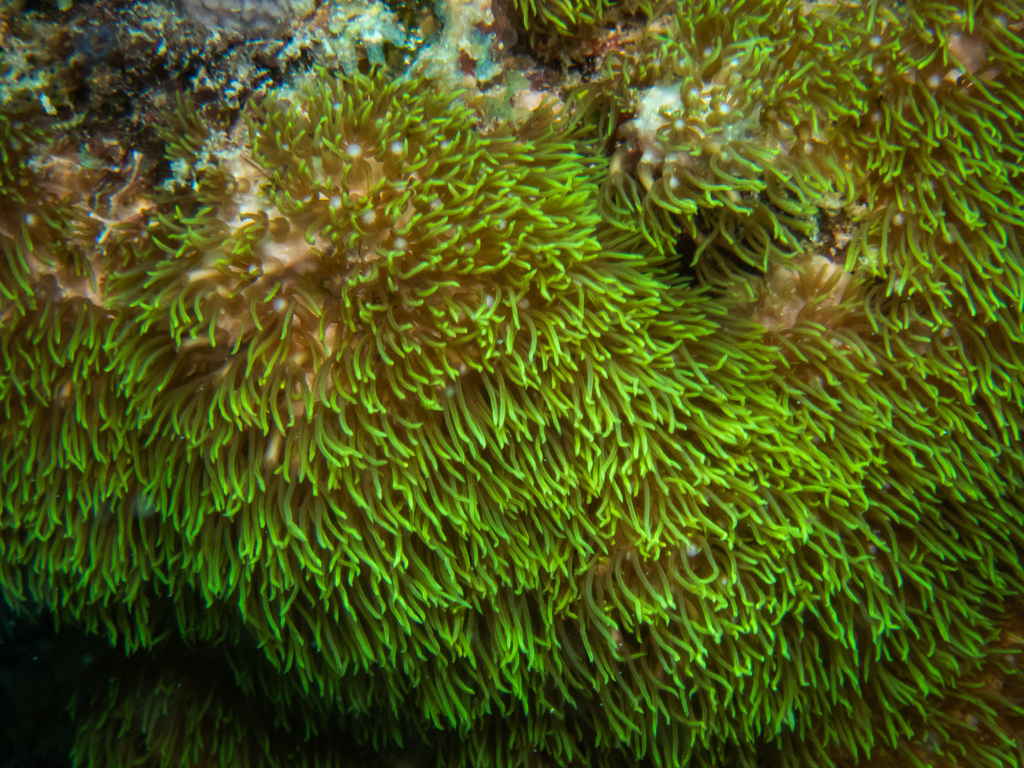
About Green Star Polyps
Bright green polyps on a purple mat. Nearly indestructible — and a known carpet-spreader. Place on an isolated rock.
Green Star Polyps are the textbook beginner soft coral: tolerant of less-than-perfect parameters, brightly colored, and flow-responsive. The catch is that they spread aggressively and can overrun other corals. Keep them on an isolated frag plug or 'island' rock — never on the main rockwork.
Notes from the editors
What it looks like. Bright green or chartreuse polyps emerging from a vivid purple encrusting mat. Each polyp has eight feathery tentacles arranged in a starburst pattern — the namesake. Color tends to shift toward yellow-green under intense lighting and deeper emerald in lower light.
In your tank. GSP grow as a creeping mat that overruns any surface it touches — rockwork, glass, plumbing, the bases of neighboring corals. The mat itself is benign and won't sting other corals, but it'll physically smother anything in its path. Polyps retracting for an afternoon is normal; fully closed for more than a day usually means nutrient imbalance or stress from an aggressive neighbor.
Placement and care. The single most consequential decision is where you put it. Glue or epoxy GSP to an isolated frag plug, lone rock, or small "island" piece — never your main aquascape. Established colonies are nearly impossible to remove cleanly; fragments left behind regrow. They're forgiving of suboptimal parameters and bounce back from neglect.
Sourcing and feeding. Universally available as captive-propagated frags for $10–25. Origin is Indo-Pacific, but virtually all hobby specimens are tank-bred — wild collection is rare. Photosynthetic, so no target feeding required; some keepers report better polyp extension with occasional phytoplankton dosing or amino acid supplements.
Care info is a starting point, not a guarantee. Individual specimens, water chemistry, and tankmate dynamics vary. Verify against multiple sources and adjust to what you observe. See our terms & disclaimers.
Related corals

Sources & attribution
- Photo: (c) portioid, some rights reserved (CC BY) · CC-BY (via iNaturalist or Wikimedia Commons).